When You Quit Working Out for a Few Years Does Muscle Come Back Fast When You Start Again
How Rapidly Can You Regain Strength After Taking a Break?

June 26, 2019
Getting ill, being injured or just needing a pause are all valid reasons to occasionally have time away from your workout routine. But sometimes these breaks last longer than we anticipate and many of united states worry we'll lose all the strength we worked so hard to build and stop up starting back at foursquare one.
It'south safe to say taking a recovery mean solar day is considered best practice for a responsible training routine. So, while a day is bully, how about a week? What about a month? How quickly do you lose force once you finish training? The answer might not be every bit fast as yous think: "Virtually experts agree that large losses in strength don't happen for about three months, with smaller, less significant losses starting around 3–iv weeks," says personal trainer Ashleigh Kast, a NASM performance enhancement specialist.
A review published in Sports Medicine, for case, found elite rugby and football game players could get iii weeks without training before their force levels started to turn down. Similarly, research on not-athletes constitute they were besides able to take iii weeks off from training without seeing any declines in strength or muscle mass.
Even if you take to take as much every bit three months off from training, residual bodacious it won't take y'all likewise long to regain your strength — especially if you were preparation consistently before your hiatus.
Exactly how long it takes to regain your forcefulness is hard to say, because it takes more than muscular strength to pull off an practice. For example, if you could deadlift 300 pounds for 6–vii reps, and and so you lot took three months off from training, you may still exist able to lift 300 pounds when yous return to training — just not for 6–7 reps.
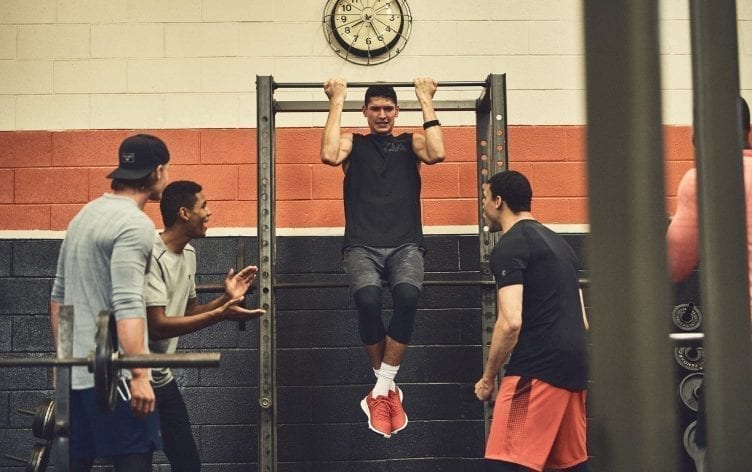
Similarly, if you could do 15 pullups earlier your three-calendar month suspension, you could probably knock out several pullups when you hop up to the bar again, but you may need to work support to 15.
The reason actually has a chip less to do with a loss of forcefulness equally it does a loss of endurance. "Doing pullups involves much more than your muscles, information technology also involves cardiovascular capacity, peculiarly if you get into the higher reps," says Dr. Laith Jazrawi, professor of orthopedic surgery and chief of the sports medicine division at NYU Langone Orthopedic Heart.
As you do more reps of an practice, your body builds up waste products like lactic acid in the musculus. With more training, your body becomes more efficient at clearing out the waste products so y'all can complete your reps without fizzling out, merely if you don't exercise for a while, it takes a piffling time to build up that endurance again, Jazrawi says.
See, cardiovascular fitness is one of the first things to become when you terminate exercising, with noticeable declines happening inside iv weeks. For example, a recent study reveals four weeks of detraining led recreational marathon runners to lose roughly 3.half dozen% of blood volume, which other research suggests may be the primary crusade for early losses in cardiovascular capacity. But proceed in listen that how speedily you lose and regain cardiovascular fitness may depend on how long you've been preparation.
When information technology comes to strength, all the same, you'll by and large keep it for much longer, and exist able to rebuild information technology fairly quickly. The reason: Your muscles "remember" the prior adaptations they fabricated from forcefulness training and tin get back up to speed in less time than it took to create those adaptations in the get-go place.
Although it's hard to offer a physical timeframe, you may be able to regain the strength lost from three months of detraining in just a couple of months. 1 study institute elderly men who paused their training for 12 weeks were able to rebuild the strength they'd lost (roughly 35%) in just eight weeks.
If y'all're restarting your strength-training routine after a hiatus, start with lighter weights or fewer reps (if doing bodyweight exercises) than you're used to. Increase the weight gradually to give your tendons fourth dimension to regain their elasticity.
See, you don't merely lose strength in your muscles when you take an extended break from lifting; yous also lose elasticity in your tendons (these attach musculus to bone), Kast says. When your tendons are elastic, they're amend able to produce and absorb forcefulness during high-impact movements, such as sprints, plyometrics and heavy weight preparation.
Co-ordinate to Jazrawi, some patients get right back to lifting heavy weights while their tendons are still stiff: "That's where they run the risk of tearing or breaking," he says. So, whatever yous do, don't try to selection upwardly where you left off.
Virtually the Writer

Lauren Bedosky Lauren is a freelance fitness writer who specializes in covering running and strength training topics. She writes for a diverseness of national publications, includingMen'due south Health,Runner's World,SHAPE andWomen's Running. She lives in Brooklyn Park, Minnesota, with her hubby and their iii dogs.
Related
Source: https://blog.myfitnesspal.com/how-quickly-can-you-regain-strength-after-taking-a-break/
0 Response to "When You Quit Working Out for a Few Years Does Muscle Come Back Fast When You Start Again"
Postar um comentário