Play It Again Sports Ice Skate Sharpening
And then there are a lot of articles about sharpening out there. Some go into slap-up detail to explain everything that could possibly be relevant to sharpening your skates, some are more than general. This one is intended to act every bit a "beginner'due south 101 guide," which volition ensure you will:
- Sympathize what the shop is actually doing when they sharpen your skates
- Be able to identify some of the potential bug in the way your skates are being sharpened
- Take a starting point in customizing your skate sharpening (specifically the hollow)
The process of sharpening – how it works
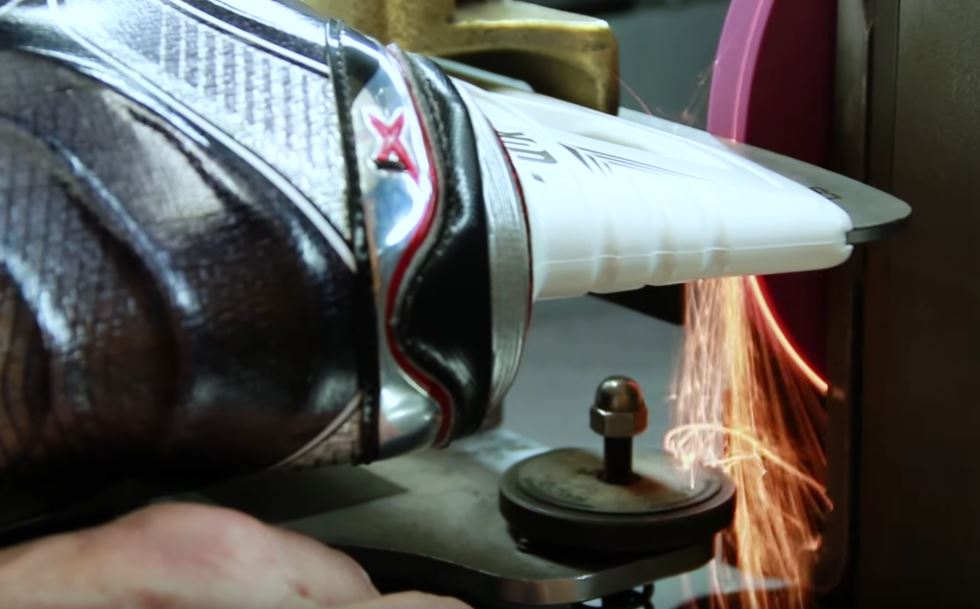
If you've ever looked closely at the bottom of your skates, you've noticed that each blade has not one edge similar a pocketknife or an axe, but rather 2, connected past a hollowed-out region in betwixt. This shape is created by passing the bract along a grinding bike (ofttimes chosen a finishing wheel). If you were to break this bicycle into two semicircular pieces, you'd notice that the cross sectional edge is rounded, similar a segment of a circumvolve. Passing your skate runner along the wheel, parallel to the direction of the cycle's travel, will impart this rounded shape into the bottom of your blade. Your skate is clamped into a jig (well-nigh commonly one that holds the blade horizontally) which is aligned with the finishing bike. The blade is then gently passed along the finishing bicycle virtually 10 times, until the edges are sharp and the bottom is fully hollowed out.
Prior to the finishing wheel, it is sometimes necessary to use an additional bike, called a cross-grinder, to prep the blade for finishing. Unlike the finishing bicycle, the cross-grinder runs perpendicular to the skate blade, is designed to dull and flatten the blade rather than acuminate it, and information technology has much more than bite than the finishing wheel. It's almost ordinarily used to "reset" the blade to a blank land, set up to be re-finished. This is an unnecessary pace for nearly sharpenings, but is great at removing defects such as bad sharpenings, major pockmarks/burrs, and rust. It's also used whenever a skate is being sharpened for the first time.
Customizing your sharpening
There are a few aspects to skate sharpening that tin can be customized, the most common of which is the hollow. As mentioned earlier, sharpening your skates involves passing them over a spinning rock with a rounded outer surface. This surface can be modified to have a very curved surface resembling a segment of a small circle, or it can be flatter, resembling part of a larger 1. Altering the shape of the wheel's surface will alter the size of the hollow information technology imparts on your skates.
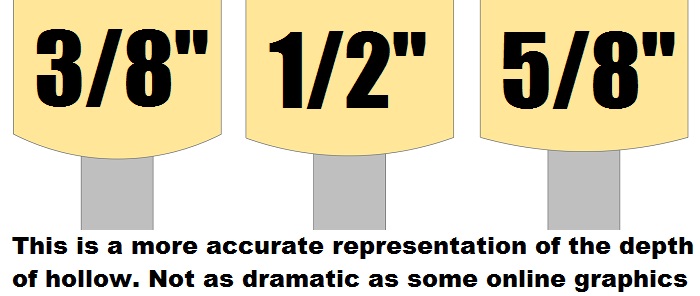
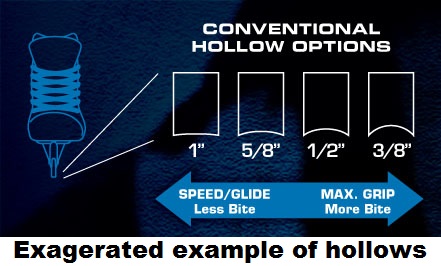
This "segment of a circumvolve" – its size in particular – is how we describe the hollow on skates. Each amount of hollow corresponds to a wheel that has been profiled so that its cross-exclusive contour would fit onto a circle with a certain radius. A larger radius will mean a flatter grinding wheel, and therefore a skate with less hollow cut away from its centre. The normal range for this is ⅜" to ¾", although higher or lower hollows are occasionally seen. Typically, skate shops will do one/2", 5/8", or 7/16" hollow as a default if they aren't given whatever specific instructions. In the pictures here, you lot can see what these hollows look like when viewed upwards close.
Unlike many other images floating around which exaggerate the differences betwixt 1 hollow and another, these ones are 100% accurate and properly drawn to scale, with the ratio between the 3mm thick blade and ½" bike contour existence preserved.
We practice this because each hollow will impact how the skate feels, and how it interacts with the ice. Deeper hollows will put more pressure level on the edges of the blade and dig into the ice more than. Shallow hollows will practise the opposite. They distribute pressure level more evenly throughout the bract, causing them to sit down more than on top of the ice.
How Hollows Affect Your Game
- Smaller radius of hollow (eg. ⅜")
- Deeper cutting on skates
- Meliorate suited to lighter players who dig in less to start with
- More energy lost into water ice
- Actress effort required to skate
- Lower summit speed
- More responsive turns and stops
- Quicker, more explosive dispatch
- Larger radius of hollow (eg. ⅝")
- Flatter cut on skates
- Amend suited to heavier players who have no trouble gripping the ice
- Less energy lost into water ice
- More efficient skating
- Faster pinnacle speed
- Turns and stops will be less quick or precipitous
- Acceleration is more limited
Other ways to customize your skate blades exist every bit well (eg. profiling the blade shape). However, these are across the scope of a typical beginner's needs.
Major sharpening issues and how to catch them
Here, "major bug" refers to things that brand your skates effectively unusable until the problem is stock-still. There are two mutual major issues that can do this. In either instance, the only solution is to become your skates re-sharpened, ideally somewhere that does a better job.
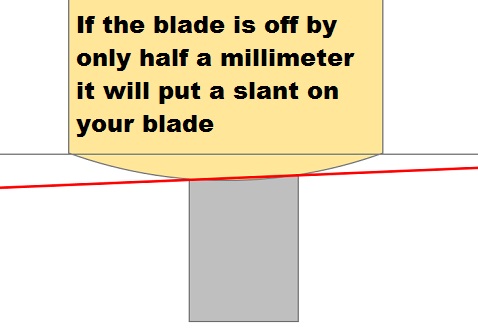
- Improper alignment:
- This happens when the sharpener didn't properly align your skate blade with the grinding bicycle. It causes one edge to be taller than the other.
- Skates will have plenty of seize with teeth when turning/stopping in ane direction, but will experience like they're slipping out when going the other manner.
- When looking down the length of the blade, you'll meet one edge is higher than the other. If you remainder a coin or other flat object on the superlative of the blade, you may find it'southward tilted also.
- Not fully sharpened:
- This is when your skates are cross-ground (either partially or fully) but then not completely hollowed back out. Skates will have very fiddling bite in every management, making it tough to push, plough, stop, or practice much of anything. This is because the blade was flattened from the cantankerous-grind wheel, but the sharpener didn't pass it over the finishing wheel enough times for it to regain its edge. Effectively, you're skating on a skate that is still cross-basis.
- When looking at the bottom of the bract, you'll see two thin lines running down the edges with a slightly dissimilar "sheen" or color. Sometimes you demand to hold the blade up to a light source and tilt back and along to see.
- If you only observe this appearance on ane edge of each bract, your skates were non fully sharpened and improperly aligned.
Modest sharpening problems to watch for
These problems won't make it impossible to skate, but they're nevertheless worth knowing about. If you're noticing that they're happening, information technology tin mean your hockey shop isn't putting very much attempt into sharpening, which increases the risk they'll make bigger mistakes from fourth dimension to time.
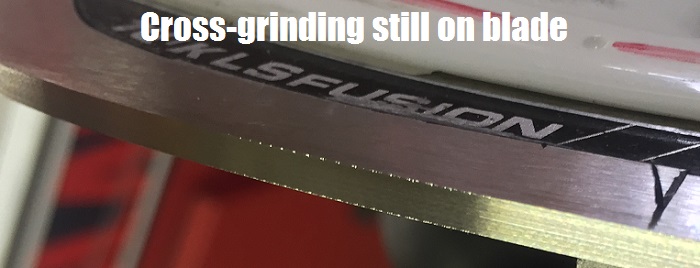
- Unnecessary cantankerous-grinding
- Cross-grinding is an first-class way to prep brand new skates for sharpening, or to remove rust or other imperfections (eg. uneven edges) left over from a previous sharpening. Different the finishing wheel, the cross-grind wheel runs vertically (perpendicular to the skate bract), so it doesn't impart its shape onto the blade. It's likewise much coarser, making it able to chew through the blade much faster. Effectively, it "resets" the blade to be completely apartment on the bottom, ensuring the it can be perfectly aligned with the finishing wheel, even if it was previously crooked or uneven.
- However, it too removes much more than steel from the blade than the finishing wheel. If your hockey shop is doing a full cross-grind every fourth dimension they acuminate, then your blades will have a lifespan of about ⅓ of what they'd take without cantankerous-grinding. Equally a compromise between precision and bract life, some shops volition do an extremely light cantankerous-grind to accept off just the edges, without removing the entire hollow.
- Over-sharpening the tip & tail
- A hockey skate is designed to be relatively (but not entirely) flat in the middle two-thirds of the bract, and rockered at the ends for agility. Maintaining this profile requires a very calorie-free touch. Not only that, but the cycle should be spending nigh all its time within the middle two-thirds of the blade. Trying to laissez passer the wheel along the unabridged length of the blade will cause it to gradually go more and more rockered over time.
- Too difficult & too fast
- To give the bract a overnice, smooth edge, your sharpener should be passing it over the bicycle slowly but lightly. Going too fast (especially on the final few passes) tin create burrs and crude spots along the edges, while pressing also difficult tin crusade the bract to "churr" on the wheel, making it discolored and slightly uneven.
Other common questions
- How oftentimes should I acuminate my skates?
- This is a very personal call. Some players will sharpen very frequently, such as every 2-iii hours of water ice time, while others go for an entire season without sharpening. If you're unsure of where to start, try getting them sharpened later on 10 hours of ice time, and then accommodate as you feel is necessary.
- Information technology'south also worth noting that colder water ice (peculiarly the blazon found outdoors) is much harder, and will dull your skates very quickly. If y'all're playing with your buddies on the outdoor rink, it'south probably a good idea to go a sharpening before your side by side game.
- What should I be doing to maintain my skates in betwixt sharpenings?
- A honing stone is a great choice for maintaining your blades. Its job is to smooth out any burrs or nicks that tin can form on the sides of your blades, which can catch the ice and slow yous down.
- Although tempting, re-edging tools (such equally the sugariness stick) cannot and should not supercede regular sharpenings. They should be used for the occasional affect-up only, if you're unable to get your skates sharpened before your big game. This is considering they don't hollow out the bottom of the blade the way an actual sharpening wheel would. Instead, they scrape away at the outsides of your blades, tapering them in to create a temporary edge.
- I've heard of a new sharpening style called Flat Bottom V (FBV). What is this, and how well does information technology work?
- FBV is similar to a traditional sharpening in the sense there'southward nevertheless a grinding bike which the skate blade is passed along. Simply instead of a circular profile, the bicycle is at present flat in the centre and cutting away further out, where the edges of the blade will exist. This makes your skate blade'due south cross-section flat in the center and angled into the ice along the edges. It'southward intended to give the user more glide without sacrificing bite equally much as a traditional sharpening would. Anybody seems to take their own stance on it – some users find it to be largely the same as a traditional hollow, while others find it profoundly improves their game. I would encourage you to try it out and form your own opinions.
Source: https://newtohockey.com/beginners-guide-to-skate-sharpening/
0 Response to "Play It Again Sports Ice Skate Sharpening"
Postar um comentário